
Why it is wrong to state that the world will severely suffer if the Strait of Hormuz continues to be closed?
- Jun 2
- 3 min read
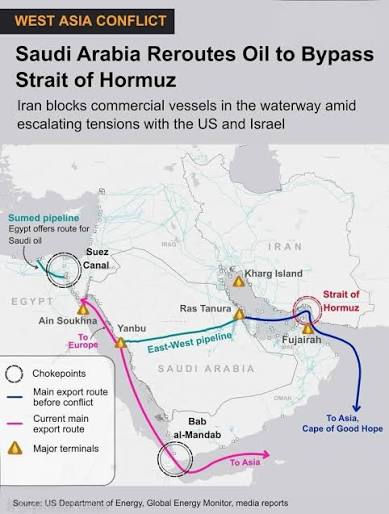
Before the war, around 25% of the world's traded oil passed through the Strait of Hormuz, meaning that approximately 20 million barrels of oil per day were cut off from international markets once the last vessels carrying these supplies reached their destinations.
However, there are several reasons why it is wrong to be overly alarmist about Iran's closure of the Strait of Hormuz following the U.S. and Israeli attacks, or to claim that key sectors of the global economy are about to collapse and that the financial markets are reacting irrationally to the war:
1. The world economy is highly globalized and has a greater capacity than ever before to adapt to oil supply shocks. Countries can diversify their oil imports relatively quickly, and the global economy is less dependent on oil than it was in previous decades.
2. The world's largest economies still possess substantial strategic petroleum reserves that could last until the end of 2026, and it is unlikely that the United States and Iran will fail to reach some form of agreement before then.
3. Before the war, the world consumed and traded around 100 million barrels of oil per day, of which approximately 20 million passed through the Strait of Hormuz. Oil prices have risen as a result of the disruption, causing many countries to reduce their oil consumption. At the same time, many oil-producing countries that do not rely on the Strait of Hormuz for exports have increased production to fill part of the gap and take advantage of higher prices.
4. The 20 million barrels of oil per day that have officially been cut off by the closure of the Strait of Hormuz are being offset in several ways:
a) Due to shortages and higher prices, global oil consumption has fallen by approximately 2 million barrels per day.
b) The United States has increased its oil exports from 3.9 million to 5.2 million barrels per day.
c) Saudi Arabia is now using its East-West Pipeline to bypass the Strait of Hormuz, allowing it to export up to 3.5 million barrels of oil per day.
d) The United Arab Emirates also has a pipeline that bypasses the Strait of Hormuz and can transport 1 million barrels of oil per day. A second pipeline with a capacity of 2 million barrels per day is reportedly nearing completion.
e) Since the removal of Nicolás Maduro from power, Venezuela has increased its oil production by approximately 300,000 barrels per day.
f) Canada, Brazil, Saudi Arabia, and Iraq have each increased production by several hundred thousand barrels per day.
g) To mitigate oil shortages, President Trump decided to ease some sanctions on Russian oil exports, bringing approximately 1 million additional barrels of oil per day onto international markets.
5) Traffic in the Red Sea is far from being blocked.
6) Having 10 million fewer barrels per day is by no means enough to cause a global social and economic catastrophe.
7) The price increases resulting from the supply shock already reflect this disruption, and besides, $100 per barrel today is much cheaper than $100 per barrel a few years ago.
8) It is true that the strategic petroleum reserves of many countries have declined compared with previous years, but this is partly because it was more economical to use them during the initial months of the conflict.
9) It is also true that oil shortages are causing, and will continue to cause, disruptions to the global economy. However, it is incorrect to claim that a major economic and social catastrophe is imminent, or that financial markets are behaving irrationally by not reacting more negatively.
10) In short, the global economy has so many opportunities for diversification that, obviously, a blockade in a strait is not going to cause the world to collapse; furthermore, it is almost impossible that Trump would allow the situation to become catastrophic and would prefer to reach an agreement with Iran that is not as beneficial to the United States and Israel.
For more questions about this or other international topics just text me on WhatsApp!


Comments